


- ICC Trophy 2001 – Canada
- Uganda 223/8 beat Malaysia 159 all out by 64 runs
- Full Scorecard: https://www.espncricinfo.com/series/icc-trophy-2001-61178/malaysia-vs-uganda-66801/live-cricket-score
Twenty-five years ago, a golden generation of Ugandan cricketers packed their bags for Toronto, Canada, to make the nation’s historic maiden appearance at the 2001 ICC Trophy.
For decades, Ugandan talent had been hidden behind the banner of the East and Central Africa combined zone – a setup where only a fortunate few ever got a true crack at the global stage.
But 2001 was different. This was Uganda, standing as a lone unit under its own flag, ready to write its own destiny.
Few could have predicted that the most defining chapter of that tournament – and perhaps the catalyst for Uganda’s entire modern cricket trajectory – would be authored by an audacious 18-year-old kid walking in at Number 10.
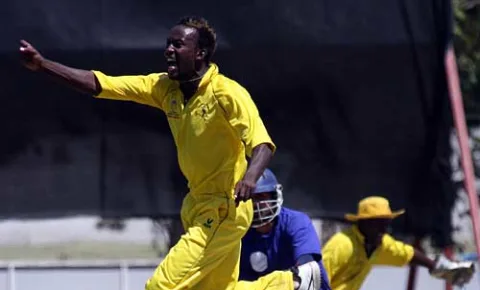
As Cricket Uganda celebrates 25 years of its extraordinary international journey, we look back at the swashbuckling carnage of Kenneth Kamyuka: the day the world noticed the Cricket Cranes.
99 for 8: The Stage is Set
It was June 2001. Uganda had won the toss against Malaysia and elected to bat. What followed was a nightmare middle-order collapse that left the team reeling at a catastrophic 99 for 8. The dream of a triumphant debut was rapidly evaporating.
Out walked young Kenneth Kamyuka. Primarily selected as an opening bowler, Kamyuka had spent his afternoon on the bench getting increasingly frustrated.
“I had been sitting on the bench watching us collapse despite a good start, and that upset me because I felt let down as a bowler; we wouldn’t have enough to bowl at,” Kamyuka recalls.
At the other end stood the experienced Richard Mwami, playing a lone-ranger innings to steady a sinking ship.
Mwami, evaluating the dire situation, met the teenager mid-pitch with a clear, conservative directive: Be cautious. Let’s scratch around and stretch this out to 130 or 140.
But Kamyuka was a teenager built on raw power and a fearless instinct to hit the ball incredibly far. Deep down, he knew a total of 130 was a slow death sentence.
“I reminded him that Malaysia had been so good in their warm-ups and anything less than 250 wasn’t going to bother them,” Kamyuka explains. “We agreed to disagree that I would be cautious, but deep down, I had made up my mind to go big or go home.”
The Carnage in Toronto
The initial exchange was a game of chess. Facing the Malaysian off-spinner, Kamyuka blocked and dead-batted the first three deliveries. Seeing the tail-ender playing defensively, the Malaysian captain signalled to his bowler from square leg, whispering to give the ball some air and finish off the tail.
Kamyuka noticed the signal. He knew exactly what was coming on ball four.
The moment the ball was tossed up into his zone, Kamyuka let fly. He launched a monstrous hit right out of the Toronto stadium, losing the ball completely. A few deliveries later, he did it again – smashing another maximum straight into the sight screen.
The Malaysian team, which had been laughing and assuming the tail-enders would throw their wickets away, suddenly stopped smiling. The West Indian community in Toronto, drawn to the sight of an underdog launching a brutal counter-offensive, began rallying behind the boys in black and yellow.
Mwami tried to pull his young partner back down to earth: “Mwami told me, ‘Please calm down, let’s hang around,’ but I had made up my mind that anything in my zone is going.”
Realising Kamyuka wouldn’t be stopped, Mwami did the most crucial thing a veteran partner could do: he anchor-dropped.
He stayed out there, holding up his end of the crease for 17 gruelling overs. While Mwami only added 6 runs to his own tally to finish on 21 not out, his survival gave Kamyuka the license to dismantle the Malaysian bowling attack completely.
Myukas Biri!
As the final over approached, Kamyuka was closing in on an unthinkable, historic milestone. Off the final delivery of the innings, Malaysia bowled a pinpoint yorker. Kamyuka dug it out hard to long-on.
For Kamyuka, it was a routine single. He was completely satisfied with finishing on 99 not out, knowing they had clawed their way to a defendable 223/8. But Mwami had other ideas.
As they crossed past each other, Mwami screamed, “Myukas Biri! Myukas Biri!” (Myukas, two!)
“While passing each other, Mwami was committed to the double,” Kamyuka narrates. “And despite my resistance, he ran and came back to the danger end, put in a dive to bring up my century.”
Mwami’s desperate dive secured Kamyuka’s name in cricket folklore: a breathtaking 100 not out off just 54 balls, littered with 8 towering maximums and 4 boundaries.
The dressing room erupted, and back home in Kampala, despite the lack of live television visuals, the cricket fraternity celebrated a moment of pure euphoria.
The performance was so stunning that even the Prince of Malaysia came to the Ugandan tent after the match to personally shake the young man’s hand.
With pockets suddenly full of match-bonus dollars from team manager Raju and the late AK Lutaaya, the 18-year-old superstar celebrated the only way a teenager knew how.
“As an 18-year-old, I wasn’t very smart with money, so I just took the boys out that night, and we had a great time,” Kamyuka laughs. “It’s one of my favourite games to remember.”
25 Years Later: The Legacy Lives On
Uganda went on to defend the total comfortably, bowling Malaysia out for 159 to win by 64 runs. The Cricket Cranes finished the group stage unbeaten, dispatching France, the East Africa Combined team, Israel, and Argentina.
While Uganda eventually fell to the UAE in the next round, the foundation had been irrevocably poured. The world had seen what Ugandan cricketers could do when given a blank canvas.
Today, as Cricket Uganda looks back on a journey that recently culminated in a historic appearance at the 2024 ICC Men’s T20 World Cup in the West Indies, the road map traces back directly to Toronto in 2001.
It traces back to a fearless generation of brothers – the Lubias, the Ssematimbas, the Nsubugas, the Kwebiihas, and the Mwamis.
And right at the heart of that history sits Kenneth Kamyuka, the number 10 batsman who refused to be cautious, stood his ground, and hit a cricket ball so far into the Canadian sky that the world had no choice but to watch.